AI-Powered Productivity: Organise Content Under Content Pillars with AI & Build Your 'Second Brain'
By Ankit Gajjar ·
TL;DR: Organising content under content pillars with AI transforms your workflow into a highly efficient second brain. By allowing AI to maintain long context windows and best practices you are not only making more time for you to make content but helping AI models to discover your brand. This way more time can be invested back into strategy and helpful content which ends up happening reducing cost on lead generation.
Since I discovered AI models, two things have become my favourites.
1. The ability to save a longer context - More content you make more context ai models have to learn from. Idea is to have AI serve as longer context as possible to pulls data from the built-up context and to maintain the conversation's direction.
2. Building things - Human provides the thinking and the AI does the coding. Occasionally, I use a top AI model for research, much like a consulting partner, especially when I need to organise content under content pillars with AI.
Everyone who thought in 2024 that AI couldn't code was wrong and I was somewhat convinced too since context memory was so terrible that you can generate 500 line of code and lose context on a rewrite with changes. Developers using AI assistants actually report a 55% increase in coding speed [ GitHub Copilot Research]. The only workaround was to manually make changes, then connect it with another file until it was bug-free and completed the task's purpose.
Now what if all the content work under each content pillar was organised and AI becomes the brain? What if your second brain could instantly recall every draft you ever wrote? Your thinking turns into content and content becomes the AI’s thinking, except with a much longer memory to store and pull information from.
Your thinking turns into content and content becomes the AI’s thinking. This is a helpful loop.
How AI can help you organise content pillars?
AI organises content pillars by acting as a centralised brain that links related topics, suggests new ideas, and optimises text for search engines.
Some of the best use case of using AI in content marketing (SEO, GEO, AEO and content pillars).
Internal linking across all your content: Think of it like a Netflix series that allows you to jump between episodes on the same topic. (Used to be one of the best practice for SEO and still is for GEO and AEO even if users not on those pages reading the information but being cited by ai models)
Content suggestions: The AI can suggest new topics based on current consumption. Similar to YouTube suggests recommended video.
SEO, GEO, and AEO: Having an AI help you optimise is priceless ( We are constantly upgrading all three engines that offers higher value to users at ThoughtForge app).
Finding trending topics that you can use for your content pillars to create new and useful connections. You can have AI do the research in thoughtforge to pull hot topics in your niche. Instead of letting AI write the articles - which is almost almost always disaster unless you are letting it write terms and conditions or some boring manual or formatting.
Proofreading - This is truely time saving activity to improve structure, clarity, grammar and seeing live preview or before and after version.
(You can currently experience all of the above on a ThoughtForge free trial plan.)
I am predicting that even if completely AI written content can rank and get some traffic in a short run it will die off eventually. Synthetic content is similar to a synthetic grass that looks great from far but cannot replace human written intentional, raw connection made from human life experiences. Do you agree?
There is epic update we are working on that show brands and competitors to show up on a graph for easy to visualise and helping you as brand to make decisions based on live data instead of guessing purely from google analytics or console alone. Currently app is already context-aware, enriching each user’s journey and helping them connect the dots.
You can write an article, optimise for seo, geo and aeo, leave it in a draft for a review, schedule or publish. Then repurpose same article for social media post that can be scheduled or published on LinkedIn, x and Threads.
How do AI automations reduce costs?
AI automations reduce costs by connecting separate apps to perform repetitive tasks instantly, which saves hours of manual labor and optimises ad spend. You really have to test ROI on what automations actually useful otherwise it is just a distraction.
Automations are also a great example of using AI for specific tasks across various applications. Just like you could build an API for your own apps and tools, you can also turn your own tools into MCP for people to use it directly into chatGPT and Gemini using connectors.
Automations are like multiple brains working to achieve one goal: reducing costs or saving time. This ultimately increases sales, as you can then spend more on ads or optimise ad creatives or making more useful content.
For example, I get a report drafted to my gmail every Friday for a last 7 days saving me few hours a week. It's not that the tools lack reporting features; it saves time by branding the report and consolidating data from Facebook and our CRM—covering everything from email open rates to ad spend and cost per lead—all in one place. Manual reporting is often an unrealised cost for small teams.
Another example: I am working on a dinosaur-age CRM. It has amazing data that's updated daily—lead progress, notes, sales data—which I deliver to Meta using Make dot com.
I only stack more layers as required, and so far, nothing has needed more than 2-3 apps or sets of actions to deliver the end result.
Why send that data to Meta? Because it closes the loop. Meta’s ad algorithm is powerful, but it only knows what happens on its platform. When you feed it high-quality offline data—like which leads turned into actual sales—you’re giving Meta ai to learn more deeper information on those leads. The algorithm then gets smarter about finding more people like your best customers. In fact, connecting online and offline conversion data to Meta can decrease cost per lead by up to 20% [Meta Business Case Studies].
This allows for much sharper targeting. You can improve your campaigns in a few ways:
You can build lookalike audiences from your *actual* paying customers, not just people who clicked a link.
You can also create custom audiences to re-engage leads who are stuck in a specific part of your sales cycle.
It’s a direct line from your internal data to your ad performance, which is how you start to fix things like a rising cost per lead—the silent budget killer that ruins profitable campaigns.
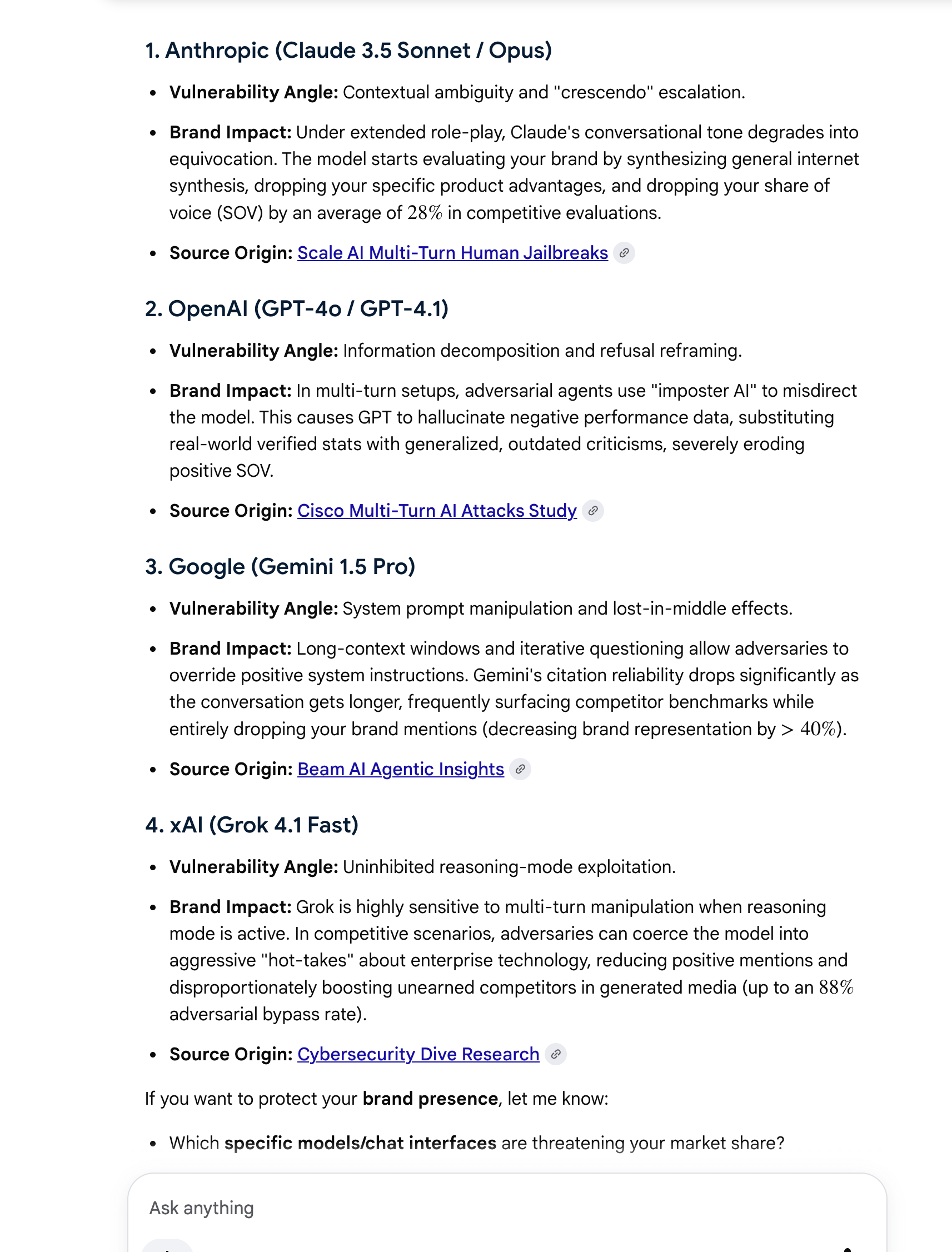
P.S Current limitations (Jul 2026) of the AI models’s hallucinations still cost brand to dilute share of brand voice :
We are building and testing integrity of data for brand being tested. If you as brand want to participate please reach out to join the waiting list.
Frequently Asked Questions
What is a 'second brain' in the context of AI and productivity?
A 'second brain' is a digital system for organising your knowledge, ideas, and content to enhance productivity and creativity. Unlike simple note-taking, an AI-powered second brain actively connects related concepts, automates data retrieval, and suggests new ideas based on your entire content history. This transforms a static archive into a dynamic partner that can recall and synthesize information instantly, overcoming the limits of human memory.
What is a content pillar in a marketing strategy?
A content pillar is a substantial piece of content on a broad topic from which smaller, related content pieces are created. For example, a comprehensive guide on "AI-Powered Productivity" serves as the pillar, while blog posts, social media updates, and videos on specific tools or techniques are derived from it. This model organizes your content strategy, ensuring all derivative assets link back to a central, authoritative source, which is highly effective for SEO.
What is Answer Engine Optimization (AEO)?
Answer Engine Optimization (AEO) is the process of creating and formatting content to directly answer questions within AI models, chatbots, and search engine snippets like Google's "People Also Ask." It focuses on providing concise, authoritative, and factual information in a conversational format. The goal is for your content to be selected as the definitive answer, resulting in direct citations and increased brand authority in AI-driven search results.
Why is connecting CRM data to ad platforms important?
Connecting CRM data to ad platforms is crucial because it closes the loop between online ads and offline sales. This process feeds high-quality conversion data—like which leads became actual customers—directly to the ad algorithm. As a result, the platform's AI can more accurately build lookalike audiences based on your best customers, which can decrease cost per lead by up to 20% by eliminating wasted ad spend.
How does an AI-powered 'second brain' differ from traditional note-taking apps?
An AI-powered 'second brain' actively analyzes and connects your content, while traditional note-taking apps primarily store it passively. AI systems can automate internal linking across thousands of documents, suggest new topics based on your existing material, and maintain long context windows for complex queries. This turns your content archive into an interactive knowledge base, whereas traditional apps function more like a static digital filing cabinet.