Does SEO Still Matter? SEO Rebranded as AEO and GEO
By Ankit Gajjar ·
Does SEO Still Matter in the Age of AI?
The core purpose behind AEO and GEO is the same as SEO: building a reputation over time so your work shows up for relevant keywords and long-tail phrases. With all these new acronyms, it's fair to ask: does SEO still matter? The answer is a definitive yes, but its application is evolving.
Are they all the same thing? With all these new acronyms, it's fair to ask: does SEO still matter?
The purpose behind AEO and GEO is the same as SEO. One needs to build a reputation over time so that their work shows up for relevant keywords and long tail phrases people search for answers, services and products.
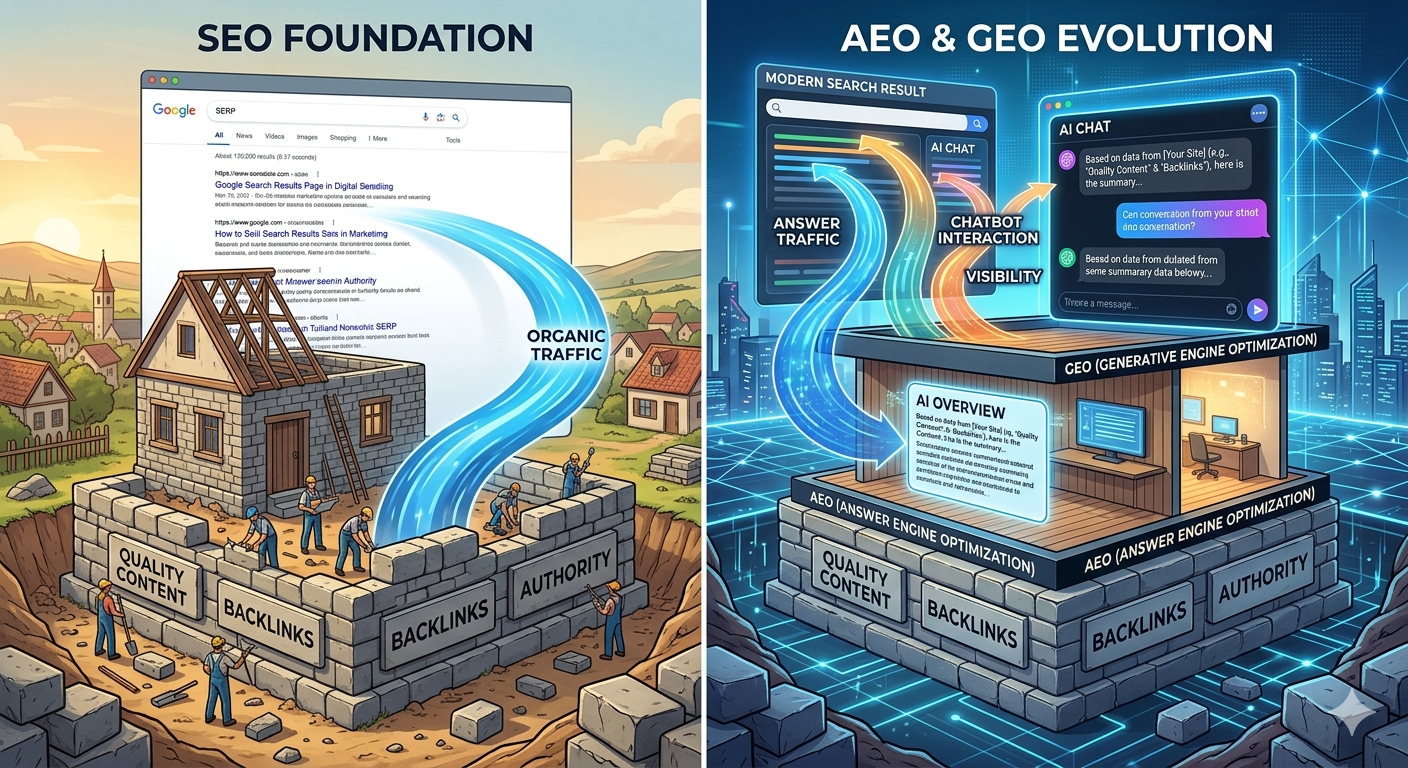
SEO = Search Engine Optimization. (Pre-AI, Google and Bing results)
AEO = Answer Engine Optimization. (AI overview)
GEO = Generative Engine Optimization. (Chatting with GPT and Gemini)
What is the Difference Between AEO, GEO, and Traditional SEO?
The core purpose of AEO, GEO, and SEO is the same—building a reputation to appear in relevant results—but the platform where users find you has evolved from search engine pages to AI-powered answers and chats. Think of it this way: SEO is the foundation you've been building for years—creating quality content, building backlinks, and establishing authority. AEO and GEO are the new floors you're adding to your house.
AEO is all about getting your content featured directly in AI-powered answer snippets, like Google's AI Overviews. It’s about being the most direct, helpful answer. GEO is about your content being used and referenced in conversational AI chats, like when someone asks Gemini or ChatGPT for recommendations. The core work is the same, but the delivery mechanism has evolved. Some reports indicate that AI-powered search could handle up to 25% of all search queries by 2026 [CITE: AI search market share projections].
While AI eats code and search, all the work you have been putting in SEO is not wasted at all, it just converts into post-AI world results. Information consumption method is upgraded to AI snippets and chat sessions.
One of the easiest ways to ensure your website is accessible is to ask AI and follow the steps- strangely I find myself building things from scratch for example all of my project websites, SAAS and websites I been making for clients are custom designed with AI with micro CMS like Wordpress.
One of the main reasons is control over customization over having to depend on legacy platforms like Wordpress - followed by available plugins tweaking them, how often do they update it, speed of pages, not able to add customisation that needed now etc.
While I run a marketing and business growth agency, I can respect that not every client wants to quickly move everything to AI. But sooner or later it’s inevitable that most sites will be made by ai because of how quickly changes can be made— a new page, copywriting, uploading media, enabling best SEO, GEO and AEO practices.
So overall nothing really has changed but for regular people AI just made accessibility much easier.
(AEO)If you want to know a specific answer - why would you want to go through a blog posts or some deep text route over a quick reply based on best of available information right now(dynamic pool). So I love the search overview shows exact answer to my question taken from high authority brand, company, individual, academic papers and so on, which then also extends into a chat session. Happy days!
(GEO) Similarly during the chat you could be reaching to new audiences while they chat with AI on the go, Gemini, chatGPT and rest of models.
How Do You Build Authority for AI Engines?
Building authority for AI engines requires consistently publishing content that demonstrates real expertise, experience, and trustworthiness through unique data, case studies, and verifiable results. I can confirm that AI is currently prioritizing content with case studies and data-based results over generic info, even if it’s a great read. When you see scenarios where this isn't the case, it's just a lack of great content waiting to fill the gap.
And Authority is built over the time with signals that AI can measure and verify. This aligns with user behavior, as studies show over 75% of users trust organic results and authoritative content more than paid ads [CITE: user trust in organic search results]. Key authority signals include:
How long the business or information has existed
How people spend time on the content (user engagement)
The volume of social shares and external references
The quality and relevance of backlinks
The demonstrated helpfulness and reliability of the information
And many more trust signals
This is where the real work comes in, and it's something AI can't fake for you. Building authority means consistently publishing content that demonstrates real expertise and experience. Are you sharing unique data from your own research? Are you presenting case studies with tangible results? This is the kind of content that AI models are being trained to recognize as high-value.
Your digital footprint becomes your resume. Every article, every backlink, and every social share is a vote of confidence. AI engines are getting smarter at connecting these dots to figure out who the real experts are. If you've been focused on creating genuinely helpful content, you're already playing the AEO and GEO game, whether you knew it or not.
Interesting times we live in:
Just like paid ads would show up first before all organically ranking content on Google pre ai, now open ai has been experimenting with running ads in chats- and at least for now they claim it’s not based on your info.
(If you are a business person reading this, go and register interest on Open AI for ads, once they open to more people - you are likely to get at late 90s ad rate)
At some point privacy line will get blurred once ads are normalised and they compete for delivering the results based on interest - Similar way how Meta allows targeting.
I have been working on Thoughtforge just to deliver all three without having to leave the platform to research keywords, meta descriptions, 18+ checklist to improve score and generating FAQs based on articles and tracking when you were referenced in post ai search based organic traffic on search overview on google to chat session.
What I can also confirm is if someone is claiming there is a shortcut to show up in these results it’s not true, in fact expertise, experience, quality, efforts, reliability, research, and case studies will be rewarded for way longer than some hacks.
Even if you ranked on AI quickly, over time, it’s a position you will lose to better and more reliable content.
My prediction is that AI-based ranking might be way more dynamic than how SEO works, because AI can switch things up quickly but great reputation built for the brand wouldn’t disappear just like that.
Remember the long wait for a page to be indexed, show up for keywords, and then track results? That entire process is about to get much faster as new info becomes part of an AI's portfolio because of transformers and graphics chips.
ThoughtForge.app SAAS is solving founder issue of filliping up content calendar with no crazy claims but your own content-article, transforming into social posts.
TF also makes it easier to optimize your content for SEO, GEO, and AEO.
Frequently Asked Questions
How do I optimize my content for AEO?
Answer Engine Optimization (AEO) is the process of optimizing content to be featured in AI-generated summaries on search engine results pages, like Google’s AI Overviews. This involves using structured data, clear headings (H2s, H3s), and providing direct, factual answers to common questions. The goal is for your content to be chosen as the most authoritative and concise source for a specific query, placing your answer at the very top of the results page.
What is the difference between AEO and GEO?
The primary difference between AEO and GEO lies in the user interaction model. AEO (Answer Engine Optimization) targets the single, definitive answer block in search results, aiming to be the featured snippet. GEO (Generative Engine Optimization) targets the conversational flow of AI chatbots like Gemini or ChatGPT, aiming to be a cited source within a multi-turn dialogue. AEO is for quick answers; GEO is for deeper, conversational discovery.
What is "authority" in the context of AEO and GEO?
Authority in AEO and GEO is the measure of your content's trustworthiness and expertise as determined by AI models. It is built by consistently publishing content with unique data, original research, and verifiable case studies. AI systems weigh signals like backlinks from reputable sites, author credentials, and how often your content is cited elsewhere. This digital reputation directly influences your likelihood of being featured in AI-generated answers and chats.
How does AI change keyword research for SEO?
AI is shifting keyword research from targeting broad, high-volume terms to focusing on long-tail conversational questions. Instead of optimizing for "digital marketing," you must now target queries like "what are the top 3 digital marketing strategies for a small business in 2024?" This requires creating highly specific, in-depth content that directly and comprehensively answers the user's underlying intent, as AI prioritizes sources that provide complete solutions.
Does technical SEO still matter for AEO and GEO?
Yes, technical SEO remains critical for AEO and GEO because AI models still rely on foundational search engine signals. Core elements like site speed, mobile-friendliness, structured data (Schema markup), and a logical site architecture are essential for crawlers to access and understand your content. Without a strong technical foundation, even the best content may be overlooked by the AI systems that power answer engines and generative chats.
What is the difference between SEO, AEO, and GEO?
SEO (Search Engine Optimization) focuses on traditional search engines like Google. AEO (Answer Engine Optimization) aims to get content featured in AI-powered snippets like Google's AI Overviews. GEO (Generative Engine Optimization) focuses on having your content cited and used in conversational AI chats like ChatGPT and Gemini.
Is SEO dead because of AI?
No, SEO is not dead; it's evolving. The foundational work of creating quality content, building authority, and establishing expertise is more important than ever. These efforts are now the basis for AEO and GEO, adapting to new ways people consume information through AI.
What kind of content does AI prioritize?
AI models are being trained to prioritize content that demonstrates expertise, authority, and trustworthiness. This includes content with original case studies, data-backed results, unique research, and tangible evidence over generic information.
How can I optimize my content for AI search?
To optimize for AI, focus on building authority by consistently publishing high-value content. Share unique data, present case studies with clear results, and demonstrate real-world experience. Your entire digital footprint, including articles, backlinks, and social proof, contributes to how AI perceives your expertise.
Will AI ranking be different from traditional SEO ranking?
Yes, AI-based ranking is predicted to be more dynamic than traditional SEO. AI can process and integrate new information much faster, potentially leading to quicker shifts in rankings. However, a strong, established brand reputation will remain a stable and crucial factor.