The $20,000 Marketing Gap: Why I’m Building a Tool for AI as a Digital Brain for Writing to Build Trust with AI Content
By Ankit Gajjar ·
Most AI content agent tools are currently producing the most boring textbooks you’ve ever seen. You have seen content all over the internet and social media. Shortcut to get attention asap. This is the exact problem I'm tackling with Thoughtforge.app, the Content Agent. The key is the concept of using AI as a digital brain for writing, not as the writer itself. It’s the only way to build trust with AI content instead of just generating noise.
Writing and creativity are soulful experiences. Until humans stop feeling emotions, AI will never "replace" a writer hence efforts to generate content that builds trust and brand is more important than ever.
But while AI shouldn't write for you, it should absolutely be your Digital Brain. I’m currently building the beta of Content Agent for ThoughtForge. It’s not an "automation" tool in the traditional, soul-sucking sense. It’s a leap forward in structure.
The Problem: Great Minds, Limited Spend
I’ve met incredible business people with world-changing ideas who are limited by their marketing spend. Even with $20k, you can only execute a few things at a high level.
The bottleneck isn't the AI—it’s the person asking the right questions.
I believe every business should automate the non-thinking, repetitive tasks that drain the human spirit. I’ve done this before:
I built tools that sync two different CRMs without Zapier or Make.
I’ve built reporting tools that pull Meta spend and GHL data instantly so clients don't have to wait for a manual report.
Now, I’m bringing that same "360-degree marketing" efficiency to content.
The Vision for an AI Content Agent Tool: 5 Levels of Agentic Power
We are evolving past simple prompts. Here is how I see the "Badass Agent" hierarchy:
Level 1: The Specialist. An agent doing a specific task or a series of tasks (e.g., scraping info on 20 competitors and building a comparison table) - you can do this today on plus plan of ChatGPT by enabling the agent mode on.
Level 2: The Team. Multiple agents communicating toward a bigger goal. Think of an IDE like Lovable or Emergent—the agent scans files, takes screenshots, finds bugs, and adds logs autonomously.
No matter what you hear about them, if you learn this - it is one of the biggest leverage you can have. Even some of reputed opinions on internet weights little truth because how fast these models are becoming great.
It took me 6 months to build production ready app clarana with basic AI all by myself in 2024 and it would take me few weeks now - that is the difference of quality and contextual memory and AI agent loops.
Level 3: Mature Collaboration. Sufficient for both digital and physical applications. This space is nuts and I am kicking myself for not building something in this space.
In a business context, this is where agents don't just execute tasks in a sequence, but truly work together with a shared understanding of the goal. Imagine a content agent drafting a blog post, which automatically triggers a design agent to create relevant visuals, which then prompts a social media agent to schedule posts for Twitter and LinkedIn, tailoring the message for each platform based on the core article. It’s a self-managing digital marketing team that understands intent.
This goes deeper than just a simple hand-off. The design agent wouldn’t just pull a generic stock photo. It would analyze the text for key concepts and emotions.
If your post is about a "bottleneck," it might generate a custom infographic of a funnel. If you write about "soulful experiences," it could create an abstract visual with specific brand colors. This isn't just automation; it's contextual creation that enhances your core message.
The social media agent would be just as smart. It wouldn't just copy and paste the title.
For LinkedIn, it might pull out a key statistic or a provocative question from the article to spark professional debate. For Twitter, it could atomize the blog post into a full-blown thread, complete with hashtags it identified from the content itself. This is intelligent repurposing, ensuring your core idea gets the maximum reach it deserves on every platform.
This same collaborative intelligence is what will revolutionize the physical world. It's not just about a single robot arm; it's about an entire factory floor where machines communicate to optimize workflow, predict maintenance needs, and adapt to supply chain disruptions in real time, all without human intervention.
Think of it as how good LLMs can hold a conversation and that is expressed by physical bots. Think of a disabled person finally having a machine that gets them.
Think of all the tiny improvements in physical machines—cars, home appliances, medicine, and so on—that were too costly for human teams to focus on but can now be enhanced.
If you want to get involve, follow founders looking for co-founders on Reddit and X, I have sometime just go away from socials to not mess with head- there is just so many opportunities and not saying all of them holds equal value but hell this best time to find something worth committing to.
Level 4: The Feedback Loop. This feels like magic. Agents that learn from your feedback, adjust to pre-set goals, and optimise based on your specific results.
Imagine this: you publish a piece of content structured by the agent. Our simplified analytics show that a specific section drove a ton of traffic from your target audience. The Content Agent sees this.
The next time it helps you structure a similar topic, it will suggest prioritizing that type of insight or framing. It’s not just taking instructions; it’s learning from real-world results what actually works for *your* brand.
This goes beyond analytics. The agent also learns from your edits.
When you rewrite a sentence for clarity or to better match your voice, the agent takes note. Over time, its suggestions become less like a generic template and more like a true partner that understands your unique style and brand identity.
It’s a system designed to get smarter and more aligned with you, the human expert, with every single interaction.
Level 5: Evolution. Agents that evolve toward complex goals, knowing exactly where to slow down for quality and where to accelerate for performance.
TF content agent will complete all 1-4 levels in 2026 and level 5 will be next carrot we will try to reach.
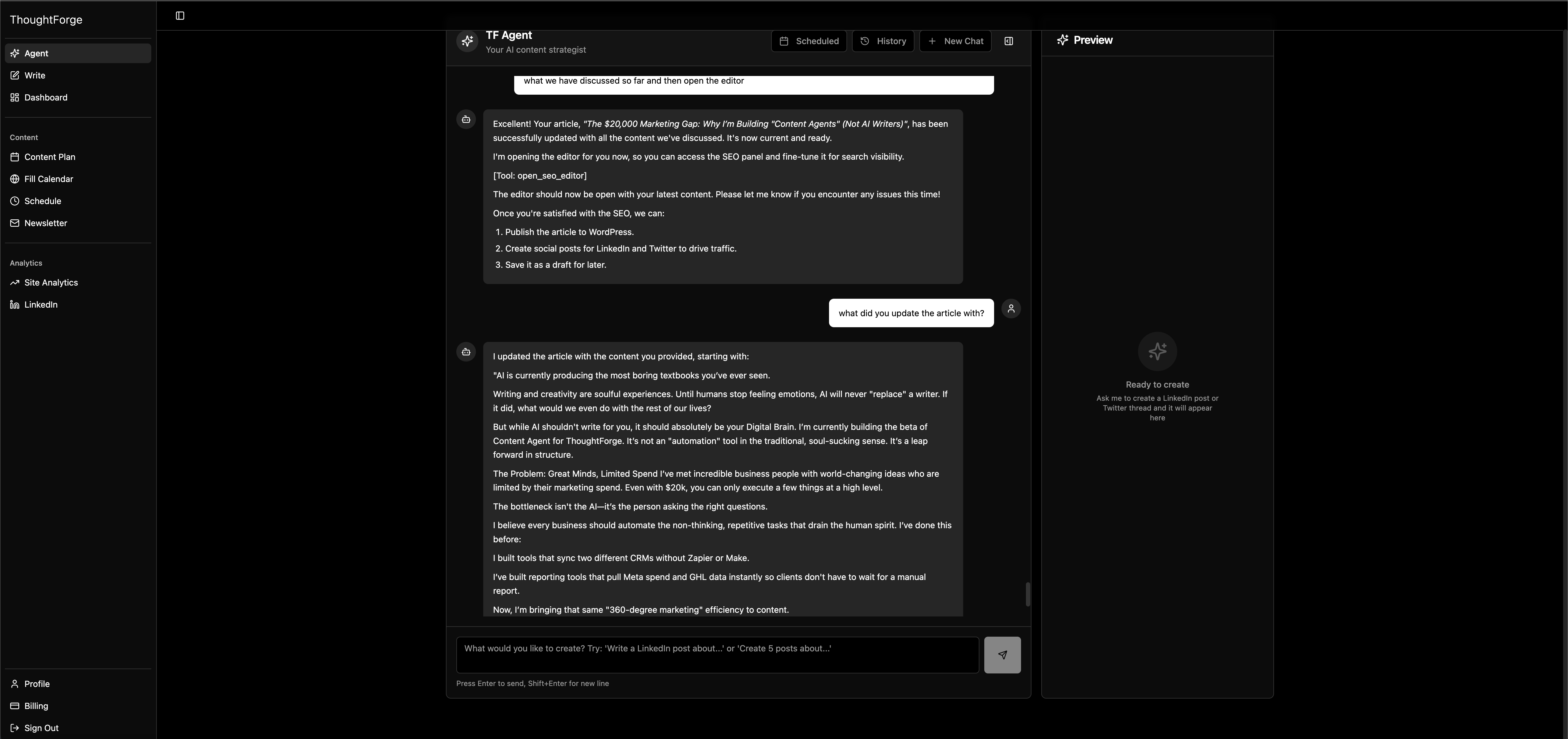
Why Thoughtforge.app is Different: Using AI as a Digital Brain for Writing to Build Trust
If you’re writing on TF, your content doesn't just sit there. If it’s relevant to your Ideal Customer Profile (ICP), we’ve built it to:
Be found automatically: Optimised for both 2026 AI search and traditional engines.
SEO + AI + Earn Backlinks: Without the manual outreach grind. This is currently in development, in a gamified way you will be able to optimise content to best SEO version with still having a manual control over content.
Simplified Analytics: No more wrestling with GA4 (Google Analytics is awesome beast just overkill for more people). TF show you your traffic (AI vs. Non-AI) in a way that actually makes sense. Idea was to quickly eliminate traffic data that is not super relevant.
ThoughtForge is about the Content Agent as a partner, not a replacement. You can switch to a blank canvas anytime to write your way—the AI is just there to recognise your brilliance and help the world find it.
SEO + AI + Earn Backlinks: Without the manual outreach grind. This is currently in development, in a gamified way you will be able to optimise content to best SEO version with still having a manual control over content.
So what does "gamified" even mean here? Think of it as a guided quest. As you write, the Content Agent will identify opportunities for internal links to your other relevant ThoughtForge articles, strengthening your site's topical authority automatically.
It’s like having an SEO expert whispering in your ear, "Hey, you mentioned 'agentic power' here, you should link to your other post that defines it." This creates a powerful, interconnected web of content that both users and search engines love.
The backlink part is where it gets really interesting. Instead of you spending hours sending cold emails, the system will identify non-competing articles on the platform that could benefit from citing your work.
It will then facilitate a "linking handshake" where both creators are notified of a mutually beneficial linking opportunity. It’s about building a collaborative content ecosystem, not just shouting into the void.
We're also exploring ways to flag external "broken link" or "unlinked mention" opportunities, turning a tedious manual task into a simple, actionable notification.
This entire process is designed to give you the upside of a full-scale SEO campaign without the soul-crushing grunt work. You focus on your ideas; the agent helps you build the authority and visibility your work deserves, turning SEO from a chore into a strategic advantage.
Be found automatically: Optimised for both 2026 AI search and traditional engines.
SEO + AI + Earn Backlinks: Without the manual outreach grind. This is currently in development, in a gamified way you will be able to optimise content to best SEO version with still having a manual control over content.
Simplified Analytics: No more wrestling with GA4 (Google Analytics is awesome beast just overkill for more people). TF show you your traffic (AI vs. Non-AI) in a way that actually makes sense. Idea was to quickly eliminate traffic data that is not super relevant.
The backlink part is where it gets really interesting. Instead of you spending hours sending cold emails, the system will identify non-competing articles on the platform that could benefit from citing your work.
It will then facilitate a "linking handshake" where both creators are notified of a mutually beneficial linking opportunity. It’s about building a collaborative content ecosystem, not just shouting into the void.
AI is currently producing the most boring textbooks you’ve ever seen. You have seen content all over the internet and social media. Shortcut to get attention asap.
This is the exact problem I'm tackling with Thoughtforge.app, the Content Agent. The key is using AI as a digital brain for writing, not as the writer itself. It’s the only way to build trust with AI content instead of just generating noise.
This goes deeper than just a simple hand-off. The design agent wouldn’t just pull a generic stock photo. It would analyze the text for key concepts and emotions.
If your post is about a "bottleneck," it might generate a custom infographic of a funnel. If you write about "soulful experiences," it could create an abstract visual with specific brand colors. This isn't just automation; it's contextual creation that enhances your core message.
The social media agent would be just as smart. It wouldn't just copy and paste the title.
For LinkedIn, it might pull out a key statistic or a provocative question from the article to spark professional debate. For Twitter, it could atomize the blog post into a full-blown thread, complete with hashtags it identified from the content itself. This is intelligent repurposing, ensuring your core idea gets the maximum reach it deserves on every platform.
Imagine this: you publish a piece of content structured by the agent. Our simplified analytics show that a specific section drove a ton of traffic from your target audience. The Content Agent sees this.
The next time it helps you structure a similar topic, it will suggest prioritizing that type of insight or framing. It’s not just taking instructions; it’s learning from real-world results what actually works for *your* brand.
The social media agent would be just as smart. It wouldn't just copy and paste the title.
For LinkedIn, it might pull out a key statistic or a provocative question from the article to spark professional debate. For Twitter, it could atomize the blog post into a full-blown thread, complete with hashtags it identified from the content itself. This is intelligent repurposing, ensuring your core idea gets the maximum reach it deserves on every platform.
This goes deeper than just a simple hand-off. The design agent wouldn’t just pull a generic stock photo. It would analyze the text for key concepts and emotions.
If your post is about a "bottleneck," it might generate a custom infographic of a funnel. If you write about "soulful experiences," it could create an abstract visual with specific brand colors. This isn't just automation; it's contextual creation that enhances your core message.