What Are Embeddings in AI and Why Do They Matter?
By Ankit Gajjar ·
To understand what are the embeddings in AI let’s take one step back into world prior to AI.
Traditional programming hits limit very quickly when we define things traditional language
Think about how messy that actually is. What if you need to account for things like:
Its size
Its family tree
Similar fruits
What makes a good apple versus a rotten one
A static definition works fine in isolation, but the second you try to build relationships between all those moving variations, the code turns into an unmanageable disaster. It is literally impossible for a programmer to write a rule for every scenario. This is the problem that led to the development of what are embeddings in AI.
Traditional logic the world of If, Else, and What If hits a brutal wall very quickly.
If we use rules to explain the world—like "birds can fly"—we run into a massive problem. You have to write infinite variations to cover the complexities of reality. For example:
What if the bird is injured and cannot fly?
What about species of birds that cannot fly, like penguins or ostriches?
What about baby birds that haven't learned to fly yet?
It’s just not practical to write a rule for every exception if you actually want to get any real use out of the software.
Ask an AI instead. It completely bypasses the rules. It looks at a map and calculates a "word family" that relates that single word to the entire rest of human language.
That difference is the key to understanding what are embeddings in AI.
Let’s be entirely clear: neither the traditional computer nor the modern AI has a single clue what the word "Apple" actually means. The machine has no consciousness. So why do we need embeddings?
Because an embedding is just a long string of numbers—often hundreds or even thousands of dimensions, like the 1536 dimensions used by OpenAI's models [CITE: OpenAI's official documentation on embeddings]—tracking a simple statistic: how often do human beings place certain words next to each other? That is the entire idea.
Instead of trying to teach a machine the meaning of a word using flawed human logic, we let it map our habits. We turned our language into geometry. When you read that an AI "understands" context, it doesn't. It just knows the exact mathematical distance between the things we say.
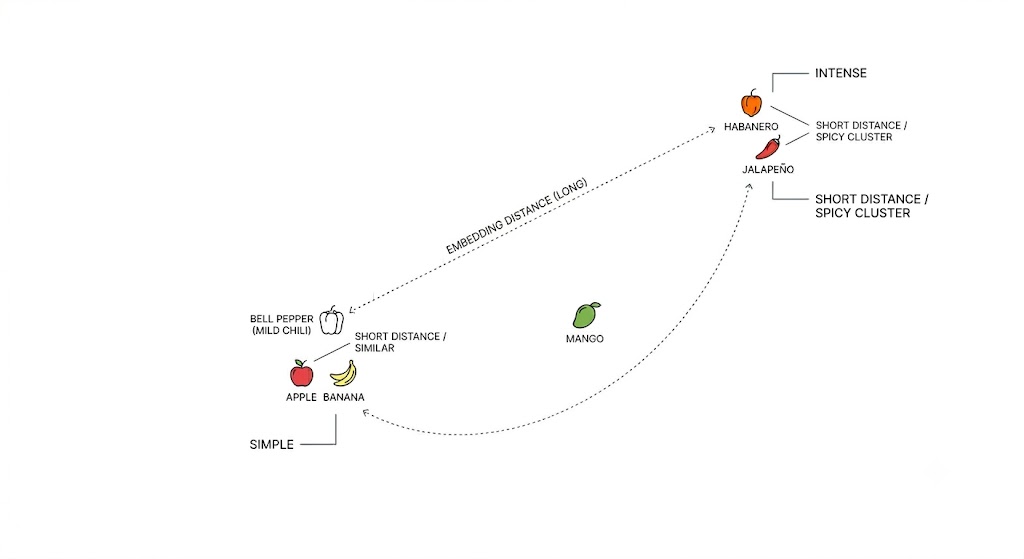
Alt: Vector Embedding Explained with an example "Apple"
Alt: Vector Embedding Explained with an example "Apple"
What Are Embeddings in AI? Moving From Rules to Coordinates
So how do you bypass the infinite "What If" loops? You stop treating words like rules, and you start treating them like coordinates.
Instead of trying to code the definition of a bird, engineers realised they could let a machine read billions of human sentences from massive datasets like the Common Crawl, which contains petabytes of web data, and simply count the patterns. The machine tracks which words naturally gravitate toward each other.
When you convert those patterns into an embedding that long string of numbers, you are essentially giving every word a physical address on a massive, multi-dimensional map.
On this map, you don’t need a rule to explain that a broken-winged bird can't fly. The machine just looks at the statistics of human language. It notices that the phrase "injured bird" frequently shows up near words like "ground," "veterinarian," or "unable to fly."
The math automatically pulls the coordinate for "injured bird" away from the "flying" neighborhood and drops it into a different zone. No programmer had to sit down and type an exception. The geometry adapted because our data adapted.
How Do AI Embeddings Calculate the Distance Between Ideas?
Because language is now mapped as coordinates, the machine can do something that static logic could never dream of: it can calculate the exact distance between two completely random human ideas. It can look at "Apple" and "Microsoft" and know they belong together in a tech neighborhood, but it can also look at "Apple" and "Pie" and know they belong in a kitchen.
We didn't teach machines how to understand our words. We taught them how to calculate the distance between our habits.
This single capability—calculating distance—is the engine behind much of modern AI. When a recommendation system suggests a new song, it's because the coordinates of that song are mathematically close to the coordinates of songs you already love. It's not taste; it's geometry.
It’s also how sophisticated search has moved beyond simple keywords. When you search for "cars that are safe for families but also have good mileage," the search engine converts your entire query into a coordinate and looks for articles or reviews that live in the same geometric neighborhood. It finds things that are conceptually related, not just textually identical, often improving search relevance by over 30% compared to older keyword-based systems [CITE: Study on semantic search performance].
The current public fixation on AI is trapped at the surface. People look at conversational chatbots and assume the breakthrough is that the machine finally learned how to talk to us. But the chat box is an illusion. The true revolution occurred when we stopped trying to explain our world to machines using definitions, and instead allowed them to map the underlying geometry of our data.
The true revolution occurred when we stopped trying to explain our world to machines using definitions, and instead allowed them to map the underlying geometry of our data.
Frequently Asked Questions
What is a vector embedding in AI?
A vector embedding is a dense numerical vector that represents a complex piece of data, such as a word, sentence, or image. Each number in the vector corresponds to a learned feature of the data, placing it as a coordinate in a high-dimensional space. For example, a 300-dimension vector for the word "king" captures its relationships to concepts like "monarchy," "power," and "man." This format allows machines to perform mathematical operations on concepts.
How are AI embeddings created?
AI embeddings are created by training a neural network model, like Word2Vec or GloVe, on a massive dataset of text or images. The model processes this data to learn the contextual relationships between items. It then outputs a dense numerical vector for each item, where the vector's position in the multi-dimensional space represents its learned meaning and associations. This process turns abstract concepts into mathematical coordinates.
How do embeddings improve search engine results?
Embeddings improve search engines by enabling them to understand the conceptual meaning behind a query, not just keywords. This is called semantic search. Instead of matching exact words, the engine converts your query into a vector and finds documents with vectors in the same geometric "neighborhood." This returns relevant results that may not contain the specific words you typed, leading to more accurate discovery.
What is the difference between an embedding and one-hot encoding?
The primary difference is that an embedding is a dense vector that captures semantic meaning, while one-hot encoding is a sparse vector that does not. For a vocabulary of 10,000 words, a one-hot vector has 10,000 dimensions with one "1" and the rest "0s". An embedding represents the same word in a much smaller vector (e.g., 300 dimensions) where each number holds rich contextual information, making it far more efficient.
Why are embeddings crucial for machine learning?
Embeddings are crucial for AI because they translate high-dimensional data like text and images into a numerical format that machine learning models can process. This conversion allows models to understand context, semantic similarity, and relationships between data points. Without embeddings, tasks like natural language understanding, recommendation engines, and semantic search would be computationally inefficient and far less accurate, as the AI would lack a meaningful way to compare concepts.
What is an AI embedding in simple terms?
An AI embedding is a numerical representation of a word, sentence, or concept, plotted as coordinates on a vast, multi-dimensional map. This allows AI to understand relationships and context by measuring the mathematical distance between these points.
Why are embeddings better than traditional rule-based programming?
Rule-based programming is brittle and requires developers to write endless exceptions (e.g., "a bird can fly, unless it's a penguin, unless it's injured..."). Embeddings learn these complex relationships automatically from vast amounts of data, making the system more flexible, scalable, and capable of understanding nuance.
What are some real-world applications of embeddings?
Embeddings are the engine behind many modern AI features, including semantic search engines that understand user intent, recommendation systems for products or music, fraud detection, and the contextual understanding that makes conversational chatbots feel more natural.
Do AI embeddings "understand" language?
No, not in a human sense. An AI with embeddings doesn't consciously understand the meaning of "apple." It only understands the mathematical relationships and distances between the numerical representation of "apple" and other words, based on analyzing how humans use language in context.